


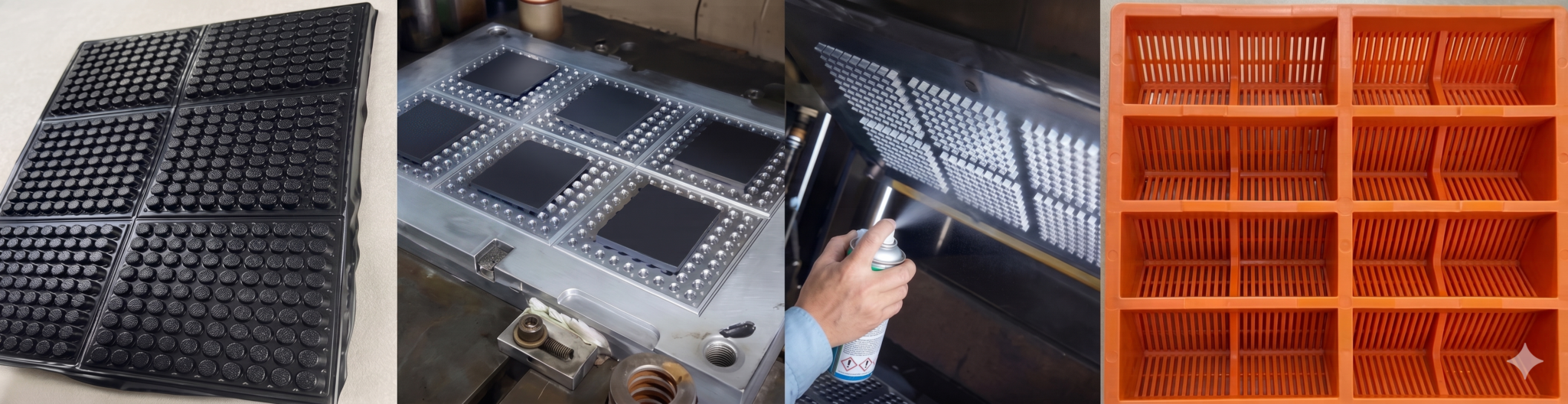
Rubber vulcanization is a critical process: high mold temperatures (150–200 °C or more), high pressure, chemical crosslinking, and strong compound adhesiveness generate a high tendency to bond to the mold, residue deposition, scale, surface variations, and extraction defects. For high-precision industries such as automotive, electronics, and medical, even slight imperfections are unacceptable and can result in costly rework or scrap.
Without an adequate detachment product, the following problems arise:
- surface defects, tears and deformations of the product
- increase in waste
- high cycle times
- increased machine stops
An effective release agent must:
- To create a stable and uniform barrier between rubber and metal
- withstand temperature and pressure without degrading
- do not interfere with the vulcanization process (crosslinking)
- ensure easy extraction and consistent surface quality
- reduce mold contamination and cleaning frequency
- last for several cycles and allow process stability
- ensure low transferability to the piece
- ensure compatibility with subsequent activities (gluing, painting, printing) when required
- be easy to apply
Common mistakes and defects on parts:
Many manufacturing defects result from errors in the use of the release agent:
- Apply too much product: (excessive application can leave films cooking on the mold) contaminated pieces, sticky pieces, presence of streaks, surface defects, dimensional variations
- Apply too little product: difficulty detaching, damaged pieces
- Application on dirty molds: residue accumulation and loss of effectiveness
- Detachant not compatible with final part requirements and subsequent treatments: problems in subsequent stages (gluing, painting, coating, printing)
- Detachant not compatible with certain compounds: chemical interaction
How to choose the ideal release agent:
There is no “best release agent” overall, nor a universal solution suitable for all applications. While theory is a fundamental element, nothing is more effective than practical fieldwork to evaluate the various alternatives available.
Based on our experience, we selected three types of release agent: two semi-permanent thermosetting silicone formulations and an innovative formulation that replaces silicone with PTFE additives.
We make these solutions available to our partners to enable compatibility testing directly within their respective manufacturing processes.
The final choice depends on:
- Elastomer type (NR, SBR, EPDM, NBR, silicone, etc.)
- Vulcanization process (temperature, pressure)
- Geometry and finishing of the piece
- Post-process needs (painting, bonding, printing)
- Automation level and mold cycles
Types of rubber release agents
Synthetic table classifying the main mold release agents in rubber vulcanization based on chemistry and carrier:
| Category | Chemical Based | Vehicle | key features | advantages | Typical criticalities |
| Silicones (traditional) | Fluid silicone oils | Solvent (hydrocarbons) | Anti-adhesive lubricating film | Excellent detachment, easy application | Possibile migrazione sul pezzo (verniciatura/incollaggio) e contaminazione superficiale |
| Silicone semi-permanent thermosets | Crosslinked silicone resins | Solvent (hydrocarbons) | Coating anti-adesivo stabile e ancorato, miglior equilibrio | Multi-cycle, low transfer to the build-up piece, less cleaning | They may require controlled application and mold preparation |
| Silicones (water-based) | Emulsified silicones | water | Film more “clean” than solvents | Low emissions, greater safety | Slow drying, shorter life |
| Slow drying, shorter life | Waxes, organic polymers, fluoropolymers, PTFE | Solvent (hydrocarbons) | Dry or semi-dry film | Maximum chemical compatibility, no contamination, excellent with abrasive compounds | VOC, flammability, cost |
| Non-silicone (water-based) | Waxes, polymer dispersions | Water | Film solido dopo evaporazione | Safety, low emissions, no contamination | Slower drying, sensitive to drying and process conditions, less “easy” detachment of silicones |
| Semi-permanent non-silicones (solvent-based) | reactive polymers | Organic solvents | Film anchored to the mold, multi-cycle | High productivity, less cleaning | Less simple application, initial cost |
| Semi-permanent (water-based / low VOC) | reactive polymers | Water or reduced solvents | More sustainable versions of semi-permanent | VOC reduction, good durability | They require tighter process control |
Compatibility table release agents to rubber
- Legend:
- ✔ = compatible / recommended use
- ⚠ = usable with caution
- ❌ = not recommended / high risk
| Tipo di gomma | |
Siliconici oil (base solvente) | Siliconici thermoset semi- permanenti | Non siliconici base acqua (cere/polimeri) Non siliconici (Fluoropolimerici)|
| EPDM (Ethylene Propylene Diene Monomer) | ⚠ | ✔ | ✔ | ✔ |
| NBR (Nitrile Rubber) | ✔ | ✔ | ✔ | ✔ |
| SBR (Styrene Butadiene Rubber) | ✔ | ✔ | ✔ | ✔ |
| CR (Neoprene) | ⚠ | ✔ | ✔ | ✔ |
| FKM (Viton) | ✔ | ✔ | ✔ | ✔ |
| Silicone rubber (VMQ) | ❌ | ❌ | ✔ | ✔ |
| HNBR ((Hydrogenated Nitrile Rubber) | ⚠ | ✔ | ✔ | ✔ |
Detachants by food sector:
Release agents “food grade” work very well as light lubricants, but in general do not withstand high temperatures and severe vulcanization cycles well. Food certification requires a less aggressive chemical formulation and the result is a lower-performing release product than non-food products.
Very approximate to me you can expect:
- 10–30 cycles for well-applied high-end H1 semi-permanent
- 1–10 cycles for simple H1 release agents
If the final piece needs to come into direct contact with food, traditional silicone is very often avoided because:
- may interfere with post-treatmentsi
- create surface contamination
- or migrate slightly.
For this reason, a lot of use is made in the food sector:
- or water-based systems
- release agent “dry film”
- fluorinated
- low-transfer semi-permanent
Conclusion
The rubber vulcanization release agent is not a simple consumable but is a determining process factor: it directly affects quality, efficiency and costs. Investing in choosing the right product means improving production performance and reducing operating costs. It is essential to rely on specific solutions that are tested on your process. We offer release solutions designed for different applications and materials, with dedicated technical support to identify the product that best suits your needs.
Contact us for a personalized evaluation.
PCT Europe