


CORROSION OF MOLDS
Steel corrosion is the main source of direct and indirect costs in the plastics processing industry. It weakens the integrity of the metal, leading to a shorter operating life of the mold, causes unsightly marks or defects on finished plastic pieces, requiring rework, requires expensive maintenance and repairs, and increases downtime while reducing overall production efficiency. Even minimal amounts of corrosion and pitting, if neglected, can cause malfunctions or total equipment failure. Even corrosion-resistant materials such as stainless steel are not immune to stains and oxide when exposed to certain circumstances.
What causes oxidation and corrosion of molds?
- Presence of atmospheric moisture, condensation, vapour residues, trapped moisture
- Use of gaseous resins that generate corrosive acid vapors (hydrochloric and hydrobromic acids)
- Use of resins containing halogenated flame retardant additives
- Use of wood fiber and bioplastic loaded compounds that generate excessive residues
- Use of resins with high process temperatures and high injection pressures
- Using compounds with highly abrasive fills
Molds must be protected against corrosion and oxidation with specific products based on the production scenario. The choice of the correct protector depends on many factors, first of all the duration of the necessary protection, the finishing of the mold, the type of corrosion to which the mold is exposed, the temperature of the surface to be protected, from the production area, possible transport of the mold, perhaps international and with different climatic conditions.
RUST AND ANTI-CORROSION PROTECTORS
HOW LONG DO YOU INTEND TO KEEP THE MOLD?
Short-term protection (one night or one weekend):
In general we recommend once the machine is stopped to always apply an anti-rust product to the mold cavity and plates. The type of protector indicated varies depending on the situation:
- Non-corrosive plastics and cooled molds:
In these cases the threat is atmospheric corrosion, mainly condensation. At the end of production we recommend first to close the cooling of the mold; then, spray a good spray cleaner with immediate evaporation that does not require manual cleaning and once completely dry give a spray of dry protector, after which close the mold. It is important to do this before water vapor in the air begins to condense.
In case condensation has already formed and water droplets are visible in the surface of the mold then dry the mold completely with a jet of air before spraying the protective film otherwise condensation is trapped between the mold and the protective film with inevitable rust formation. With this sequence that takes a couple of minutes, the mold is effectively protected from condensation that is generated during heating of the mold which can lead to the formation of oxide and rust. The advantage of using a dry protector is that you can restart production quickly without having to wash the mold to remove the protector.
- Plastics developing corrosive gases (acetates, PVC, halogenated)
With such gaseous resins the threat is chemical corrosion generated by corrosive acid gases emitted by the plastic material during molding. At the end of production, the first thing to do is always a powerful spray with a valid spray cleaner, assisted by a vigorous wipe with a cloth. Flame retardants contain extremely aggressive halogenated additives, it is essential to remove them before applying the protective agent otherwise they are sealed under the protective layer and corrode the mold. If the mold is heated (50°-100°C) a cleaner with a strong controlled evaporation chemistry should be used. Once cleaning is complete, proceed with the mold protection. In these cases, it is essential to use a protective coating with a specific dual-action formulation, that is, to prevent rust formation and neutralize the action of the corrosive acidic fumes that have impregnated the printer surface. If the mold is hot, the rustproof product protects the mold as it cools. If the heat is extreme, it can cause the oils contained in the rustproof product to liquefy and drip. However, it still provides an important level of protection until the next production start. This procedure is always indicated with hot molds even in cases of long production or mold storage stops because it allows the mold to be protected until the mold is cold enough to be manipulated. This is a so-called intermediate step between the production stop and the mold cleaning restart or activity suitable for thoroughly removing contaminants accumulated on the mold unit during the production cycle before storage.
Long-term protection (months or years):
In these cases the mould must first be thoroughly cleaned and subsequently protected. Applying the protector without first thoroughly cleaning the mold is a useless and detrimental operation because it creates a water-repellent film over a layer of various types of contamination in contact with the steel, which can affect the steel undisturbed and cause significant damage.
- Storage of the mould within the holding
In these cases, use a protector suitable for the period of time the mold will remain in storage. There are long-term anti-rust products that are effective for up to five years of indoor storage. In these cases, for greater safety, we always recommend using a dual-action protective agent containing inhibitors to atmospheric corrosion and also acid chemistry.
- Protection of a mould which is to be transported
Molds shipped abroad by truck often stop in very different climatic conditions and experience temperature changes that put the steel to the test. The same applies to sea transport which exposes molds to a highly corrosive environment due to the presence of sea salt, moisture and salt spray which accelerate the degradation of metallic materials. Effective prevention requires the use of specific protectants and packaging. The protector must be specially formulated to ensure effective protection against the threats listed above, and we recommend a protector with an additional colored tint to ensure complete and uniform coverage on all mold surfaces and avoid leaving exposed areas.
Protection of a mold with a mirror finish
Mirror-polished molds are particularly delicate because the presence of oxidation stains may require polishing the surface. It is essential to effectively protect them with a self-cleaning dry protector that requires little or no contact with cleaning cloths. A self-cleaning anti-rust product usually fades when production starts after a couple of molding cycles or can be easily removed with a fast-evaporating mold cleaner.
Protection of a medical sector mold
You are printing parts that will be released into the medical or food market and will only need to consider a formulation certified for these areas.

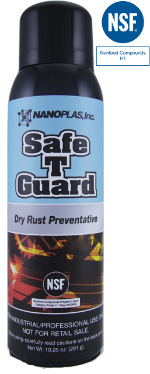
Safe-T-Guard™
NSF H1 Certified Dry Rust Remover
Eliminates moisture and prevents corrosion from penetrating the mold. It is an authentic dry rust remover, it dries immediately avoiding oily drips. It adheres perfectly to the walls creating a very thin but powerful dry water-repellent protective film that does not degrade grease and other lubricants already present on the surface. It also works as an excellent lubricant for moving mold parts and is NSF H1 certified for food grade and medical grade applications. Ideal for protecting mirror-polished surfaces because it is self-cleaning and does not require manual removal of the protector. Safe-T-Guard is designed for indoor rust protection and is not suitable for multi-day transport. Also ideal for protecting cutting tools (spindles, cutters, pliers, tips, blades) from corrosion,
various dusts and pollutants
Features:
• Does not drip, does not move from the application areaazione
various dusts and pollutants
• Chemical composition that eliminates moisture
• Excellent film durability
• Does not degrade fat
• Silicone-free
• NSF H1 Certificate
• Self-cleaning, removes with a couple of molds, no need to clean the mold
• Suitable for surfaces up to max 50°C
Mold Protect H1
NSF H1 Certified Dry Rustproof Color
Mold Protect H1 effectively prevents corrosion and surface oxidation on ferrous and non-ferrous molds and tools exposed to harsh environmental conditions during production shutdowns and extended storage. Mold Protect H1 dries immediately after application, leaving a dry, thin, opaque protective layer on treated surfaces. Mold Protect H1 self-eliminates from the cavities of treated injection molds after three to five injection cycles. It does not penetrate the ejection units.
Features:
• Does not drip, does not move from the application areaazione
• Chemical composition that eliminates moisture
• Yellow tint allows for easy visibility during application
• Does not degrade fat
• NSF H1 Certificate
• Self-cleaning, removes with 3-5 moulds, no need to clean the mould
• Suitable for surfaces up to max 50°C
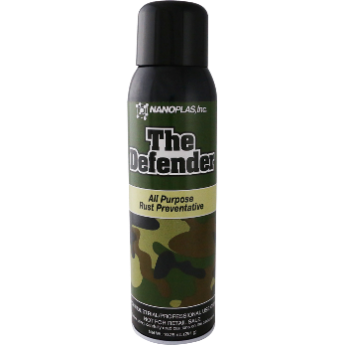
The Defender™
Double-action semi-dry protector
Defender features a semi-dry formulation with neutralizing additives that allows for prolonged protection from atmospheric corrosion and acid corrosion caused by gases emitted by PVC and other materials. It allows complete and long-lasting protection for up to 3 years without causing oozing in the mold. It contains a green tracer dye showing where it has been applied, providing visual evidence and assurance that the mold is adequately coated while avoiding overdose.io.
Features:
• Does not migrate or cause oozing
• Green tint allows for easy visibility during application
• Protects when molding PVC or other corrosive materials
• Semi-dry for longer-lasting protection
• Suitable for hot surfaces up to 80°C°C
• Disappears after 3-4 prints, no need to remove it with solvents
•Adjustable spray to apply the amount of product neededa
•Absolutely silicone-free
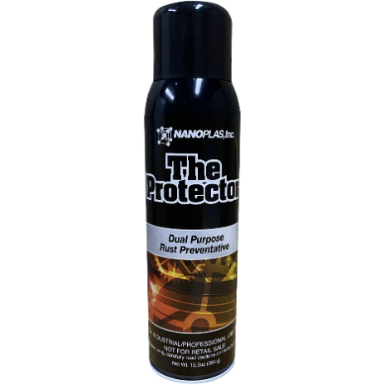
The Protector™
Long-term double action protector for hot surfaces
The Protector generates a waxy film designed for long-term mold storage and mold transfers that travel for several days in countries with different climates. It is a dual-purpose rust inhibitor and designed for use on both cold and hot molds. It allows for longer-lasting protection without causing oozing. Contains acid vapor neutralizer additives that protect against PVC and other corrosive materials. The mold needs to be cleaned before use to remove the waxy film, but it is not difficult to clean and is not as heavy as an oil-based rust remover.etroli.
Features:
• Chemichal that removes moisture
• Does not migrate or cause oozing
• Formulated for hot or cold molds
• Protects when molding PVC or other corrosive materials
• Protection for up to 3 years
• Easy to remove
• Suitable for hot surfaces up to 100°C
• Absolutely silicone-free