


Cleaners, Degreasers and Speciality Cleaning Products
Cleaners, Degreasers and Speciality Cleaning Products
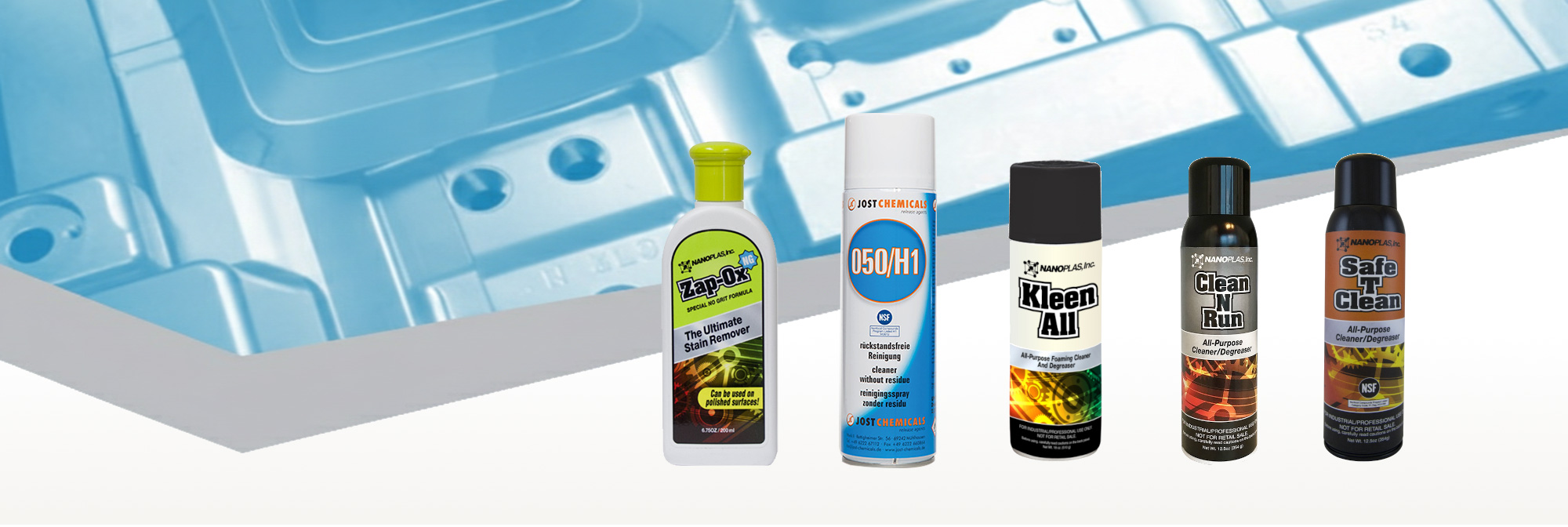
A clean mold will work efficiently for a long time without requiring extraordinary intervention.
Deposits and accumulations of contaminants trigger corrosive phenomena in the mold and compromise the quality of the molded parts.
Printer surfaces are particularly exposed to contamination and should be cleaned thoroughly.
The die plates, extraction tables and press plates of the injection machine must also be kept clean, corrosion between these plates can cause misalignment which affects the distribution of clamping force and die wear.
Continue reading
Efficient cleaning must be thorough, rapid, avoid waste of product and energy, must not compromise treated surfaces, and must be as respectful as possible of human health and the environment.
Mold cleaners play a key role.
Using the wrong cleaner is a huge waste of time and labor.
But what is the “ideal” detergent? The correct detergent is one with the chemical characteristics suitable for performing a specific job in a given application.
In the following pages we will try to help you in defining the detergent that is right for you.
HOW TO CHOOSE THE CORRECT MOLD CLEANER
It depends on the nature of the contamination, the type of steel, the finish, treatment, temperature of the surface to be cleaned, the working environment, whether the mold is mounted in a press or available on the bench
TYPE OF CONTAMINATION: If the contamination to be removed consists of residues of oil, grease, release agents, dust then a valid universal degreaser with a powerful jet should be sufficient without requiring other interventions.
If the contamination is more tenacious and the mold is stained with degraded resin, gas deposits, and various types of stains, it is necessary to select a specific and powerful chemical formulation capable of breaking the molecular bonds between the contamination and the steel and facilitating such removal.
In these cases, the flow and chemical action of the solvent is not sufficient; manual mechanical action with cloths and sponges, even abrasive ones, may be necessary.
In the presence of oxidation or in a more advanced stage of actual corrosion, it is essential to use a specific cleaning product to neutralize the corrosive effect at work and subsequently protect the surface.
SURFACE TEMPERATURE TO BE CLEANED: Temperature greatly affects the effectiveness of a cleaning product. Fast evaporating solvents work very well on molds at room temperature as they act without leaving residue and do not require mechanical cleaning, while they tend to evaporate too quickly on a hot mold, completely losing effectiveness as they do not stay in contact long enough to perform a thorough cleaning.
In contrast slow evaporating solvents formulated to work well at elevated temperatures are less effective at room temperature in that they take too long to evaporate and leave residues requiring manual removal.
WORKING ENVIRONMENT: Should the molded parts be used in the food or medical field, a detergent with the necessary requirements and certificates will be required.
SURFACE FINISH TO BE CLEANED: If the surface to be cleaned has a mirror finish or photo-etching, only residue-free quick-evaporating cleaners, specific stain removers that are absolutely non-abrasive, and, if necessary, specific PU sponges and microfiber cloths should be considered.
CLEANING HOT MOLDS IN MACHINE Numerous thermoplastics contain complex chemical and physical additives that create contaminating deposits on the mold surface composed of very strong and difficult-to-remove intramolecular bonds.
The same applies to fire-retardant materials and resins that release aggressive gases that adhere firmly to the mold wall. In these cases, a two-stage cleaning is essential.
Step 1 sponge a powerful, slow-evaporating chemical mixture, with an active ingredient capable of remaining in contact with the hot topfice long enough to cleave the strong bonds between the mold and the contamination.
Step 2 spread a heat-resistant penetrating stain remover cream into stubborn areas, let it sit for a few minutes, rub with a suitable cloth if possible, then remove the cream and spray the cleaner again. To our selection of cleaning products:
- Safe-T-Clean
- Fluid 050 / H1
- Clean-N-Run
- Blizzard
- Zapox