


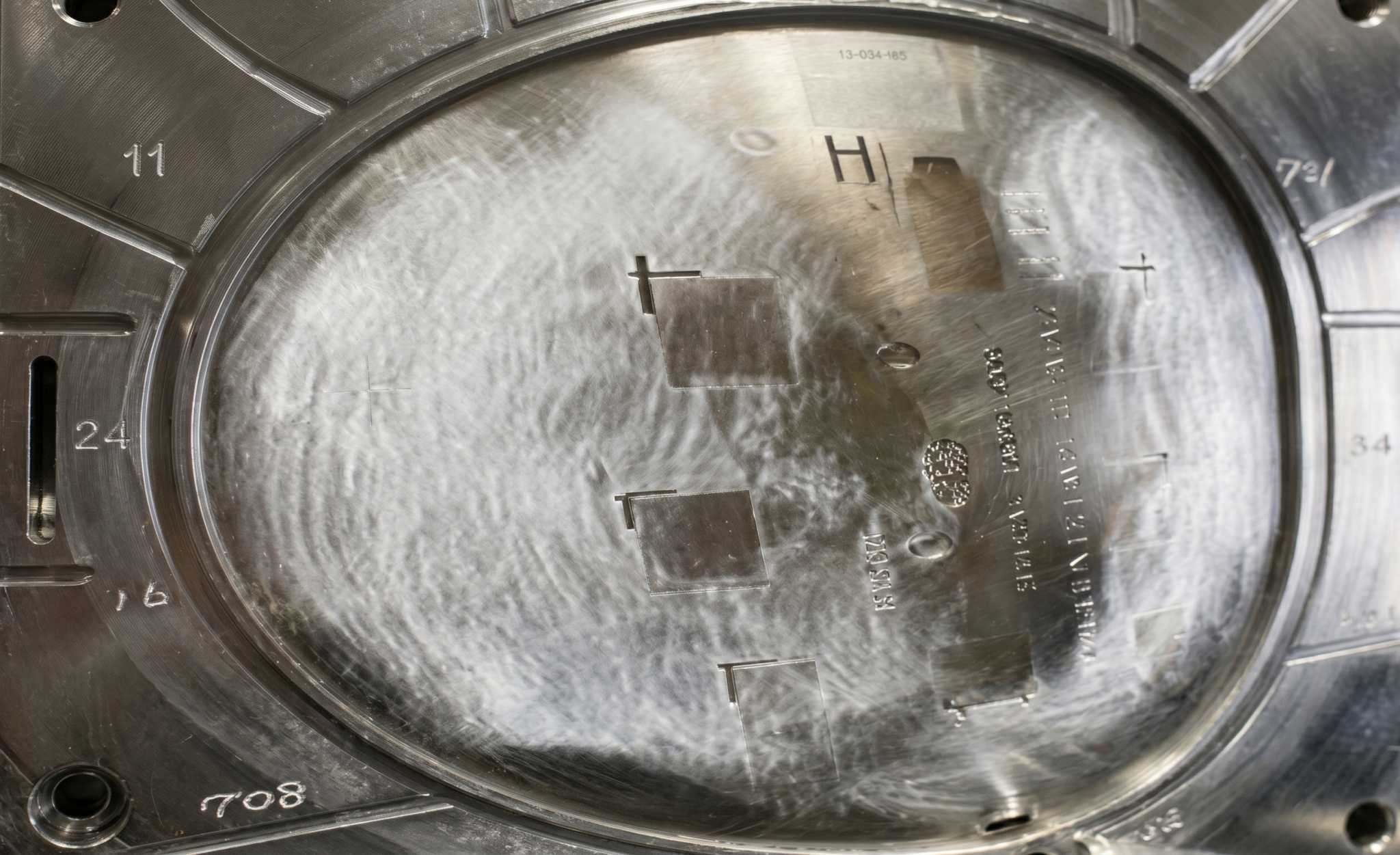
POM is tough!!
POM (polyoxymethylene) is one of those materials that does not forgive. It has low thermal stability and a very narrow process window (about 200-230°C) so little is needed for it to begin to degrade and decompose, releasing corrosive gases and residues. High temperature, residence time in the long cylinder, excessive injection pressure cause rapid decomposition of the POM.
The POM mainly releases two types of deposits:
1. The “Plate-out” (white powder plating)
È il deposito più comune e insidioso. Si presenta come un residuo di polvere bianca finissima o una patina opaca che si accumula nelle zone più fredde dello stampo.
- What it is: These are fragments of degraded polymer (low molecular weight), additives (lubricants, stabilizers) and products of thermal decomposition.
- Where it is found: Typically in gas vents, dead corners, on the faces of dowels and extractors.
- Conseguenze: Ostruisce gli sfiati (gas trapping), causando bruciature sul pezzo (effetto diesel) o impedendo il riempimento completo. Può migrare sui pezzi causando difetti superficiali (inclusioni bianche, perdita di brillantezza). Se non rimossa, sotto pressione la polvere si compatta diventando una crosta dura che aumenta l’attrito e usura su colonne, guide, bussole, estrattori causando rallentamenti e grippaggi.
- Where it is found: Typically in gas vents, dead corners, on the faces of dowels and extractors.
2. Acid gas deposits (corrosion)
POM, as it degrades, releases formaldehyde, which in the presence of moisture can transform into formic acid.
- What it is: It is not a solid deposit in the strict sense, but a chemical reaction that attacks steel. It manifests as a dark “bloom” or localized rust.
- Where it is found: Everywhere the gas stagnates, often under the layer of white dust.
- Conseguenze: Rovina permanentemente la finitura superficiale dello stampo (pitting), rendendo l’estrazione del pezzo sempre più difficile.
Aesthetically, this can cause the printed piece to:
- silver burns and streaks on the piece
- air bubbles or voids on the surface of the printed piece
- variazioni di colore, ingiallimento del materiale
WHAT TO DO:
More frequent mold cleaning is essential. Gaseous residues must be promptly removed before paraformaldehyde penetrates the microporosity of the metal, causing irreversible damage, and the white powder must not accumulate and compact, forming a hard crust that is difficult to remove.
CRITICAL ASPECTS IN CLEANING:
POM has two properties that make it a fantastic material for mechanics (no wear, no rust, self-lubricating) but a nightmare when it comes to mold cleaning:
- High crystallinity (physical structure):
POM has a highly crystalline structure, which means that its polymer chains are organized in an orderly manner and tightly packed. This structure prevents solvents from penetrating between the polymer chains, separating them, dissolving them making the material structurally unassailable. Crystallinity protects the POM surface, solvents do not penetrate.
- Low surface energy (chemical nature):
POM is chemically inert, has a stable structure, the molecules are so close and well bound together within the solid that they do not need to seek chemical bonds with external substances. The polymer chains are closed and offer no attachment points (reactive sites) and entry points to solvents or other chemical agents. In summary, liquids do not adhere.
Practical advice:
- Fortunately, what is deposited in the mold is not healthy POM but rather thermally degraded fragments with a much lower molecular weight, making them easier to chemically remove than healthy POM.
- Fresh residue comes off within minutes, “cooked” residue creates crusts and can require hours and more aggressive intervention.
- The temperature (50–80 °C) greatly helps to soften the POM residues in the mold without “baking” them and facilitates mechanical removal.
- For exposed and reachable mold surfaces, the “flash” method with the mold in the machine is effective, without dismantling the mold and taking advantage of the temperature.
CLEANING PRODUCTS:
- Specific chemicals:
Effective solvents for POM are very limited because the material is chemically resistant, but you can use:
- Strong solvents based on ketones and ethers (acetone, ethanol, etc). They are the only ones who can soften this material and be able to peel it off. It is advisable to proceed with caution because such powerful solvents can damage some materials (aluminum) and surface treatments. Proceed with caution and without excessive exposure. Before applying the solvent, test it on a small area to avoid damage to the mold.
We recommend trying the FORMCLEAN PLUS spray cleaner (JOST CHEMICALS), which is very effective at removing carbonized polymer residues and free of corrosive compounds, or the CLEAN-N-RUN (NANOPLAS USA).
Correct procedure:- Apply the product to a soft cloth and remove dirt, or apply it directly to the affected parts and surfaces by spraying it (distance approximately 25 cm).
- Let the detergent sit for a couple of minutes. Next, remove the residue with a cloth.
- Optimal cleaning performance is achieved at temperatures between 40 °C and +80 °C. The maximum operating temperature is +125 °C.
- Strong solvents based on ketones and ethers (acetone, ethanol, etc). They are the only ones who can soften this material and be able to peel it off. It is advisable to proceed with caution because such powerful solvents can damage some materials (aluminum) and surface treatments. Proceed with caution and without excessive exposure. Before applying the solvent, test it on a small area to avoid damage to the mold.
- Water-based cleaning foams containing surfactant mixtures designed to penetrate impurities, detaching them rather than dissolving them. Foam cleaners can be very useful for quick and preventative maintenance to remove “light–medium” incompletely charred POM residue, especially on textured photo etched surfaces. The foam adheres to surfaces (even vertical ones), penetrates micro-cavities (embossing), softens POM residues making them easier to remove with a non-aggressive mechanical action (soft nylon brush or very fine brass). On cooked/old residues, the effectiveness of the foam is limited, requiring a stronger cleaner or aggressive mechanical intervention. Foams are no substitute for real cleaning if the mold is very dirty. They also work on mirror-polished surfaces but should not dry, and we recommend a final wipe with a soft cloth with isopropanol (or a little acetone) to avoid the risk of streaks if not removed well.
We recommend trying KLEEN-ALL Foam Cleaner (NANOPLAS) or FS-77 FOAM CLEANER (JOST CHEMICALS).
- Water-based cleaning foams containing surfactant mixtures designed to penetrate impurities, detaching them rather than dissolving them. Foam cleaners can be very useful for quick and preventative maintenance to remove “light–medium” incompletely charred POM residue, especially on textured photo etched surfaces. The foam adheres to surfaces (even vertical ones), penetrates micro-cavities (embossing), softens POM residues making them easier to remove with a non-aggressive mechanical action (soft nylon brush or very fine brass). On cooked/old residues, the effectiveness of the foam is limited, requiring a stronger cleaner or aggressive mechanical intervention. Foams are no substitute for real cleaning if the mold is very dirty. They also work on mirror-polished surfaces but should not dry, and we recommend a final wipe with a soft cloth with isopropanol (or a little acetone) to avoid the risk of streaks if not removed well.
Correct procedure:
- Warm mold (40–70 °C)
- Spray the foam evenly
- Let it act for 30–90 seconds (don’t let it dry out!)
- Remove:
- microfiber → mirror-polished areas
- nylon brush → texture
- Compressed air to dry completely
- Final pass with Isopropanol for mirror finish
Mistakes to avoid with foam cleaner:
- Let the foam dry → residue/film
- Use it on a mold that is too hot → it evaporates immediately, ineffective
- Do not rinse/remove well → streaks or contamination of pieces
- Use products that are too aggressive (some contain strong alkaline agents)
Practical consideration for foam cleaner:
- Embossed surface (texture) → excellent solution
- Mirror polished surface → OK but with care and final finish
- Heavy/cooked residues → to be supplemented by other methods
2. Controlled mechanical cleaning:
In the case of cooked residues and crusts, mechanical intervention is inevitable.
- Use of microfiber cloths (on polished surfaces)
- Non-abrasive brushes or scrapers soft brass or nylon to remove surface residue without damaging the mold.
- Possible use of compressed air to eliminate dust and debris
WHAT TO DO AFTER CLEANING THE MOLD:
- Once the mold has been cleaned and dried, a valid self-cleaning spray “dry” protector is recommended in case the mold is still for a few days or a double-action protector (anti-atmospheric rust and anti-acid corrosion) in case the mold is stored for a long time.
- If, on the other hand, we start production right away, we suggest a valid semi-permanent release agent that allows for easy detachment and protects the mold surface, delaying contamination.
For technical details about products and use please contact us.
PCT Europe
+39 0422 1788181
Services: